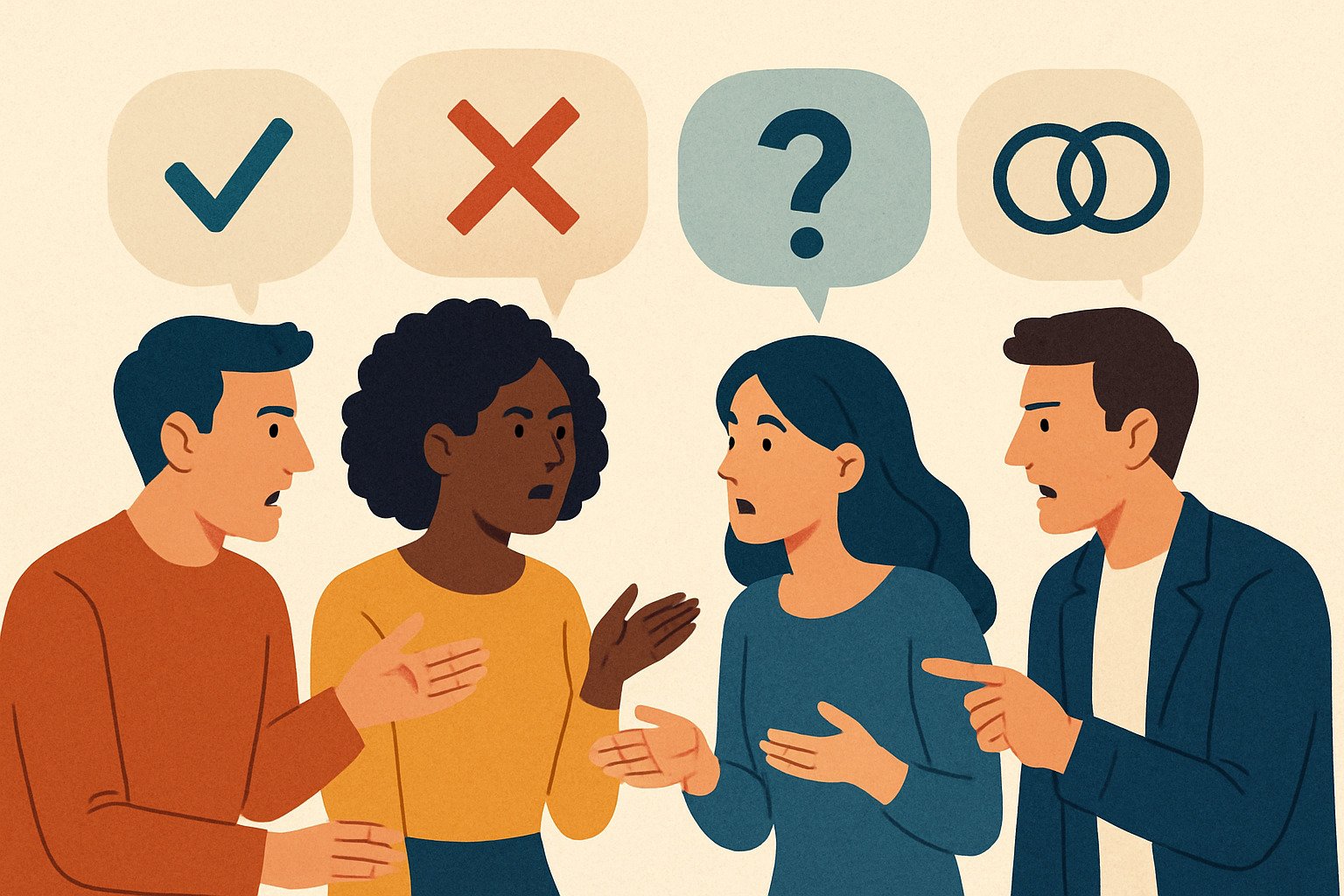
To disagree productively means more than just keeping your voice down. It is not about winning or losing a debate. Instead, it is about exchanging views to reach a better solution or a deeper understanding. You stop trying to defeat the other person and start trying to solve the problem together.
Many of us grow up thinking that conflict is inherently negative. We avoid it to keep the peace. However, conflict is actually a critical opportunity for growth. It sparks innovation and can even strengthen relationships. When you navigate a disagreement well, you learn things you never would have discovered in silence.
The goal of this article is to teach you how to navigate a difficult conversation with confidence. You will learn to express your difference of opinion without damaging the connection. You can stand your ground without burning bridges.
Jump To Section
Why is it so hard to keep cool when we disagree?
You might wonder why a simple conversation about politics or chores makes your heart race. The answer lies in the psychology of the threat response. Your brain is wired to protect you from danger. Unfortunately, it often treats a difference of opinion the same way it treats a physical threat.
When someone challenges your view, your brain triggers a fight-or-flight mechanism. Your body floods with cortisol and adrenaline. You are biologically primed to attack or run away, not to listen and reason. This makes it incredibly hard to stay calm.
There is also a deep link between our ideas and our identity. We often attach our self-worth to our beliefs. When someone challenges a core belief, it feels like a personal attack on who you are. This leads to immediate defensiveness. You stop protecting your point and start protecting your ego.
Emotion plays a massive role in these moments. Strong feelings can cloud logic. It becomes difficult to process information accurately when you are angry or scared. You might miss key details or misinterpret the other person’s tone.
Finally, we have to address the ego-driven desire to be right. It feels good to win. This urge often overrides the more constructive desire to find the truth. We prioritize victory over mutual agreement, which shuts down any chance of progress.
Setting the Stage: What is your intention before you speak?
Preparation is key to a good outcome. Before you enter a potentially volatile conversation, you need to pause. Assess your mindset. If you go in looking for a fight, you will find one.
Ask yourself about your internal motivation. Are you entering this discussion to learn and understand? Or are you simply trying to force the other person to agree with you? If your goal is coercion, the conversation is doomed before it starts.
Adopt a mindset of curiosity. Approach the topic with the genuine goal of understanding the other person’s perspective. This shifts the dynamic from combat to collaboration. You become an investigator rather than a warrior.
It helps to establish a shared goal or intention at the very start of the interaction. You might say, “I know we see this differently, but I want us to find a solution that works for both of us.” This lowers defenses. It reminds both parties that you are on the same side.
Checklist: Are you ready to engage?
- Is my goal to understand or to win?
- Am I calm enough to listen?
- Do I value the relationship more than being right?
- Can I identify a shared goal we both want?
How can you disagree without being disagreeable?
Now we shift from mindset to the actionable mechanics of the conversation. Having the right attitude is the first step, but you also need the right tools. Here is how to handle the exchange itself.
Can you separate the person from the idea?
You must depersonalize the argument. This is the most essential technique for keeping things civil. You need to attack the merit of an idea without attacking the character or intelligence of the person holding it.
When you attack the person, they will shut down. They will fight back to protect their dignity. Instead, direct your focus entirely on the concept at hand. Treat the problem as a third object in the room that you are both looking at.
Here are some examples of how to shift your language:
| Instead of saying this (Personal Attack) | Try saying this (Critique the Idea) |
|---|---|
| “You are being reckless with the budget.” | “I find that spending plan risky because…” |
| “You’re ignoring the facts.” | “I think there is some data here we haven’t considered.” |
| “That is a stupid idea.” | “I am not sure that approach solves the root problem.” |
| “You are being stubborn.” | “It seems we are stuck on this specific point.” |
This separation allows the other person to remain open. They do not feel the need to defend their worth, only their viewpoint.
Are you listening to understand or just waiting to talk?
Active listening is difficult during a heated topic. Most people engage in mental rehearsal. This happens when you plan your rebuttal while the other person is still speaking. If you are planning what to say next, you are not listening.
You miss the nuances of their argument when you do this. You might even miss the fact that they actually agree with you on some points. To fix this, you need to slow down.
Use a technique called looping or reflection. Before you make your point, repeat back what you heard. You can say, “So what I am hearing is that you are worried about the timeline.”
This gives the other person a chance to clarify. It also proves that you value their input. You cannot have a productive disagreement if you don’t understand the other side.
Can you find the “Steel Man” in their argument?
You may have heard of the “Straw Man” fallacy. This is when you attack a weak or distorted version of your opponent’s argument. It is a cheap way to win. The “Steel Man” is the opposite.
To Steel Man an argument, you build the strongest possible version of the other person’s view. You try to articulate their position even better than they did. You look for the best evidence that supports their side.
This demonstrates that you truly respect their position. It shows you have listened thoroughly. When you can state their case clearly, they trust you.
Imagine you are arguing about a project deadline. Instead of calling them lazy, you say, “You want to push the deadline because you want to ensure quality control is perfect, right?” When they hear this, they relax. They become far more willing to listen to your counterpoints because they feel understood.
How do you find common ground when you are worlds apart?
Even in a major disagreement, there is usually common ground. You just have to dig for it. Often, people agree on the destination but disagree on the route.
Shared values often underlie opposing surface-level opinions. For example, two parents might argue about a curfew. One wants it earlier for safety; the other wants it later for independence. The fight is about the time, but the shared value is raising a capable, safe child.
Identify these shared values. Use them as a bridge. You can say, “We both want what is best for the kids. How do we balance safety and freedom?” Now, you are problem-solving together.
Another powerful tool is using “and” instead of “but.” The word “but” acts as an eraser. It negates whatever came before it. If you say, “I see your point, but I disagree,” the person only hears the disagreement.
Try swapping it. Say, “I see your point about safety, and I also think we need to consider their social development.” This validates their view while introducing yours. It allows two truths to exist at the same time.
Leadership and Team Dynamics: How does this apply at work?
Disagreement is not just a personal skill. It is a professional necessity. Whether you are a leader or a team member, how you handle conflict defines your success.
Why should a leader encourage dissent?
A leader who surrounds themselves with people who only agree creates a dangerous blind spot. If everyone nods along, you miss critical flaws in your plan. You need people to challenge you.
Constructive conflict is the engine of innovation. A team that feels safe to disagree will vet ideas more thoroughly. They will spot risks early. This leads to better decision-making and stronger results.
True leadership is about creating a psychologically safe space. In this environment, a difference of opinion is viewed as a valuable asset. It is not an act of insubordination. It is a sign that your team cares enough to speak up.
How do you manage disagreement in a meeting?
Meetings can quickly derail when conflict arises. You need practical strategies to keep the discussion on track. First, set ground rules early. Establish that challenging ideas is okay, but interrupting is not.
If a specific argument between two people drags on, use the “parking lot” method. Acknowledge that the issue is important, but note that it is consuming too much time. “Park” the topic on a whiteboard or list.
Agree to discuss the parked item later with just the relevant parties. This ensures the meeting stays productive for everyone else. It validates the issue without letting it hijack the agenda.
What should you do when the conversation goes off the rails?
Sometimes, despite your best intentions, emotions will boil over. You are human. When this happens, you need a strategy for de-escalation.
Recognize the physical signs of anger. If your face feels hot or your voice is shaking, it is time for a structured pause. Suggest a “time out.” This is not just for children.
You can say, “I am feeling frustrated, and I want to have a productive conversation. I need a ten-minute break to cool down.” This allows your cortisol levels to drop. You can return to the topic with a clearer head.
There are also times when you will not reach an agreement. That is okay. You can agree to disagree. This is a valid conclusion. It means you accept that you view the world differently on this specific topic.
Walking away is not losing. It is a strategic move to protect the relationship. If the conversation is no longer constructive, ending it is the smartest thing you can do.
Conclusion
Learning to disagree productively is a lifelong journey. It requires you to separate identity from ideas and check your intentions constantly. You must listen actively to understand, not just to reply.
Remember that the goal is not to eliminate conflict from your life. Conflict is natural and necessary. The goal is to change how you handle it.
View your next disagreement as a puzzle to be solved together. Approach it with curiosity and respect. When you do this, you transform tension into trust. You have the tools to turn every argument into an opportunity for deeper connection and better understanding. Now, go use them.